
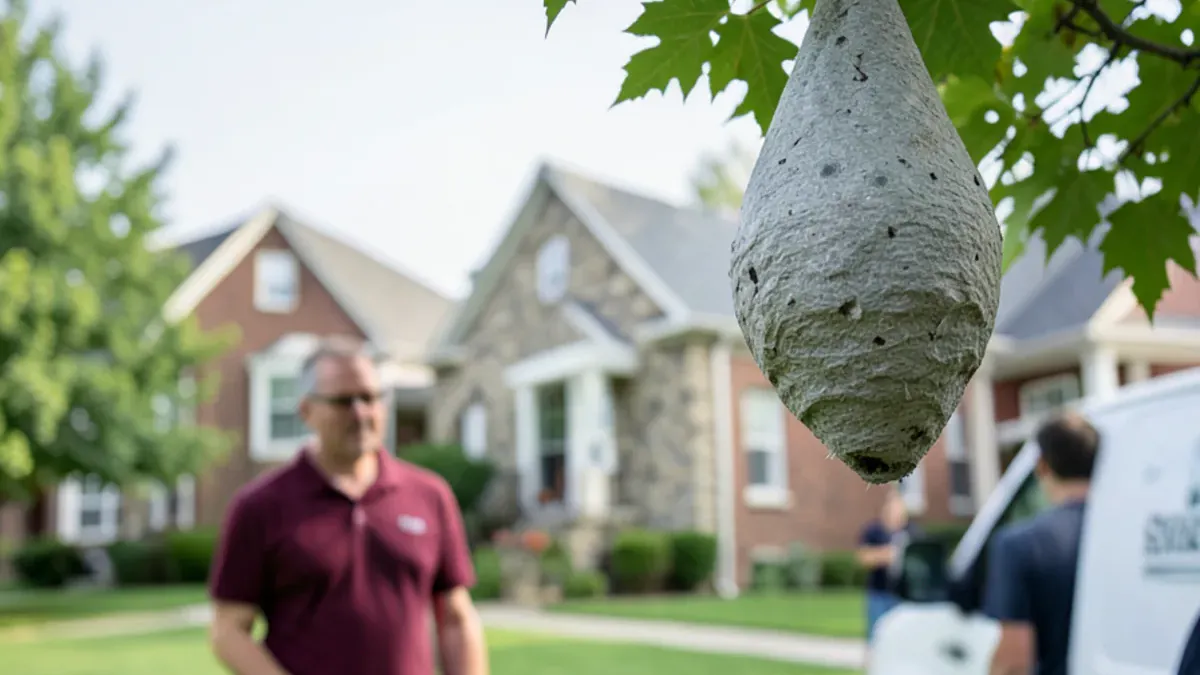
The fastest way to settle wasp vs hornet vs yellow jacket is to study the nest, not the insect darting past your head. Shape, building material and location narrow the answer in seconds, and you can read all three from across the yard. Below is how we sort out the stinging insects Pennsylvania homeowners run into, plus what each answer means for safety.
Why the nest tells you more than the insect
Stinging insects move fast, and most people only get a blurred look at yellow and black. Nests stay put. A paper wasp builds an open comb you can see straight into, a bald-faced hornet wraps its colony in gray paper, and a yellow jacket usually hides its nest out of sight entirely.
Getting close enough to count stripes is how people get stung. Use binoculars or your phone's zoom from well back, ideally in the cool early morning.
How do you identify a wasp nest at a glance?
Match where the nest sits and how it is built, then confirm with the insect description.
| Insect | What it looks like | Nest shape and material | Typical spot around a home | Peak activity |
|---|---|---|---|---|
| Paper wasp | Slender, long legs that dangle in flight, brown with yellow or reddish marks | Single open comb of exposed cells, like an upside-down umbrella, hanging from a short stalk | Porch ceilings, eaves, shutters, deck railings, grill lids | Late spring through summer |
| Bald-faced hornet | Black body with ivory-white markings on the face and tail end | Enclosed gray paper ball or teardrop with one opening near the bottom | Tree branches, shrubs, and sometimes eaves or siding | Mid to late summer |
| European hornet | Large, brown and yellow, often flies at night toward porch lights | Enclosed paper nest hidden inside a cavity | Hollow trees, wall voids, attics, barns | Late summer into fall |
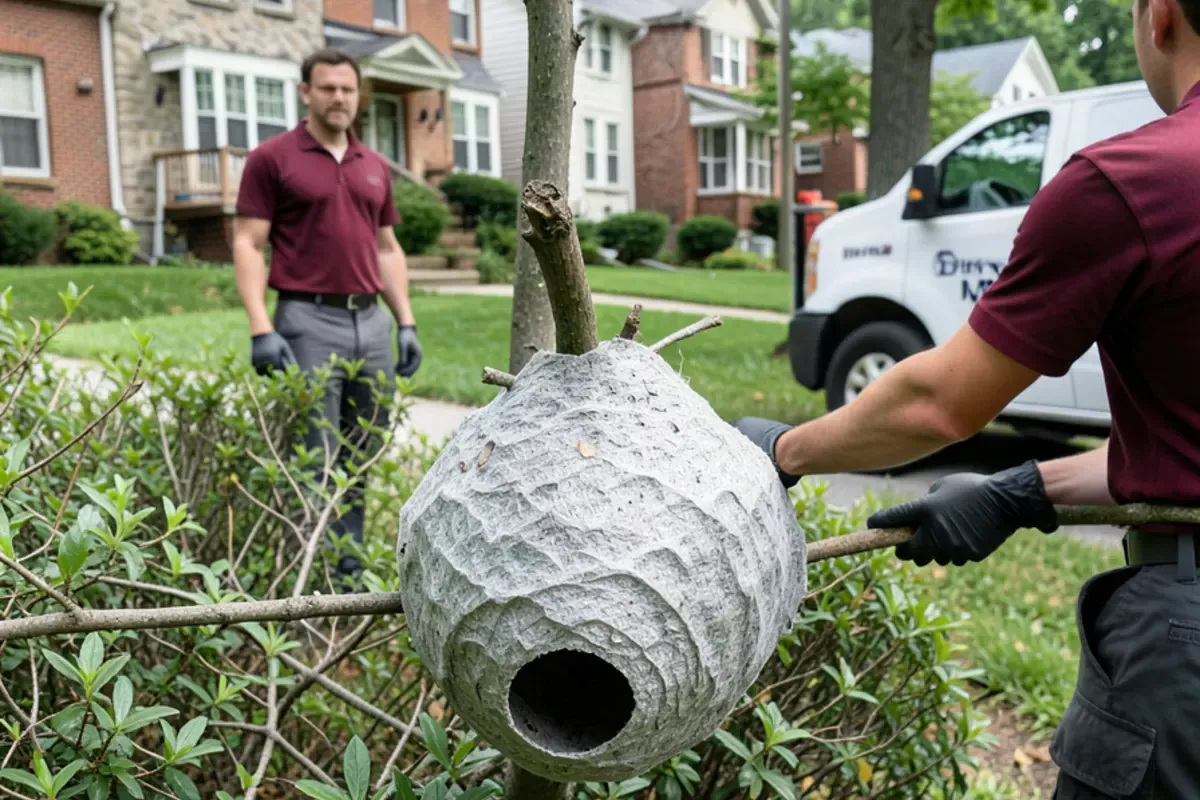
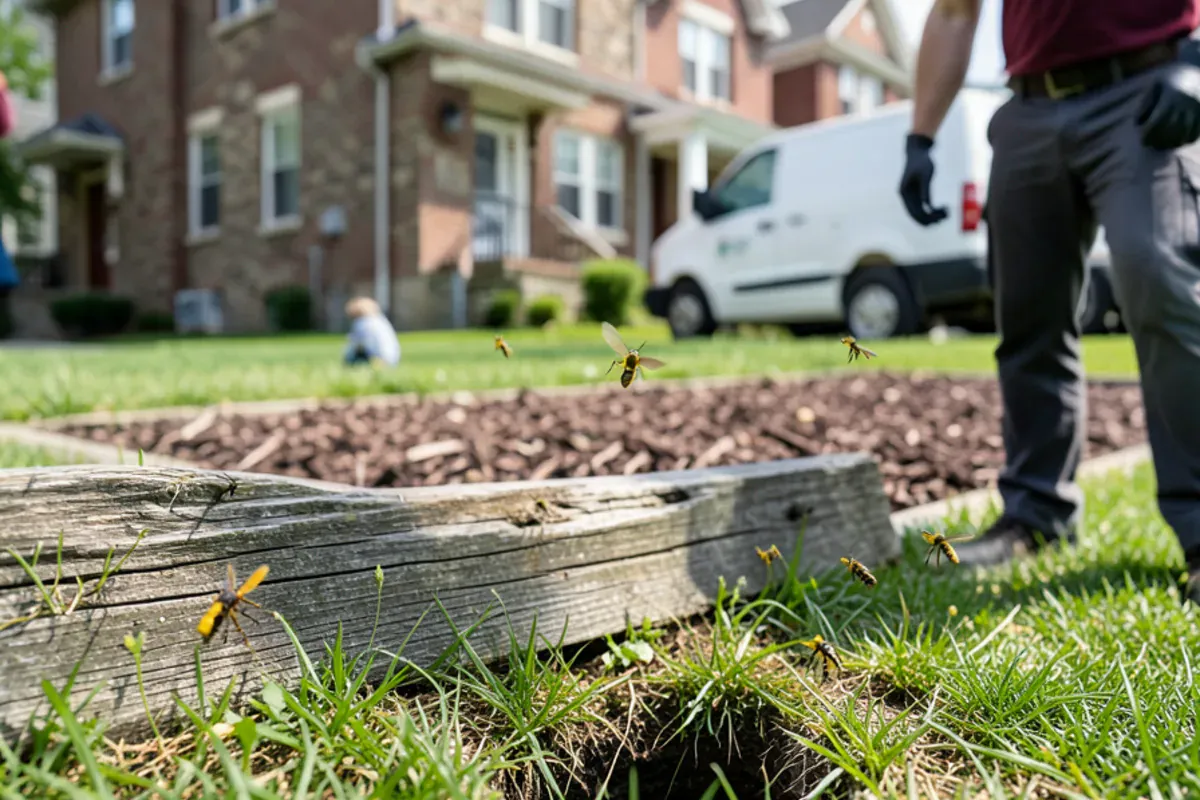
| Yellow jacket | Stocky, bright yellow and black bands, quick zigzag flight | Enclosed paper nest you usually cannot see | Holes in lawns and beds, under landscape timbers, inside walls | August through the first hard frost |
| Cicada killer | Very large, rust and yellow, often mistaken for a hornet | Single burrows with a mound of loose soil at the opening | Bare or sandy soil along walks and beds | July and August |
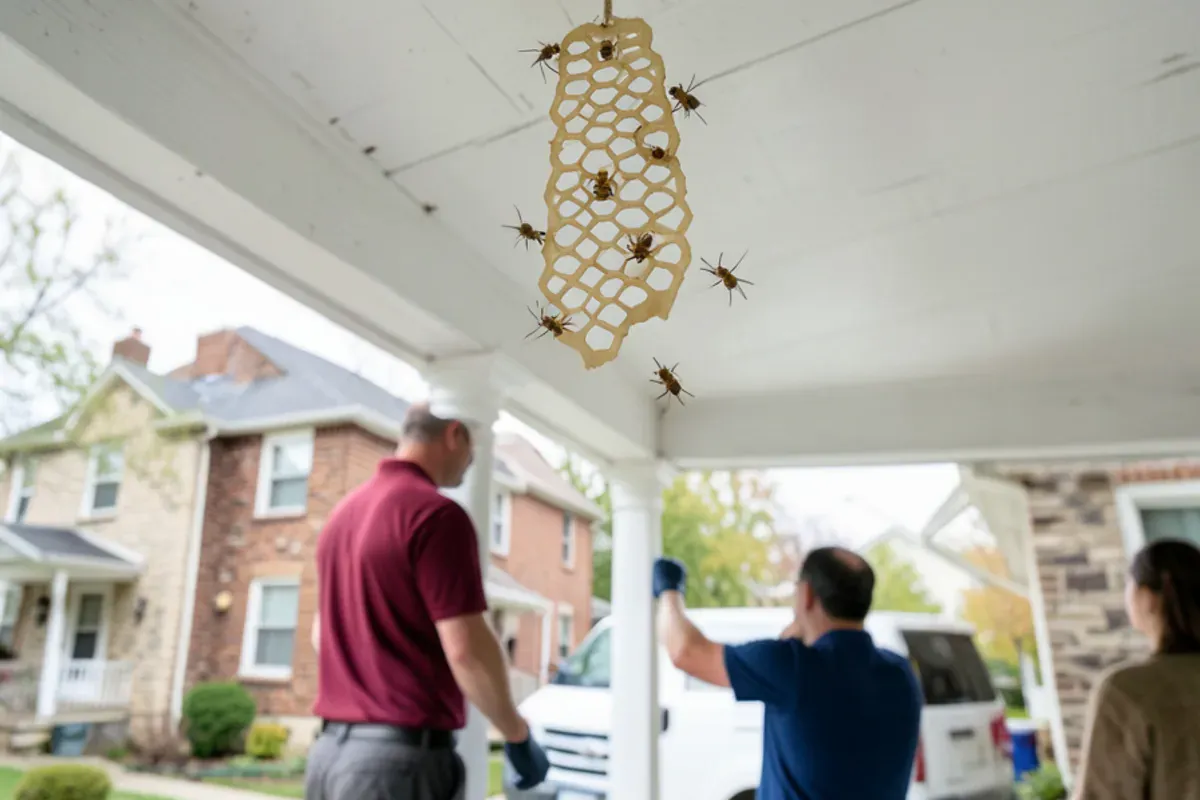
Paper wasp nest: the open umbrella under your eaves
A paper wasp nest looks like a small honeycomb made of gray paper, open on the bottom so you can see the cells. Most stay smaller than a fist and hold a few dozen wasps. They favor sheltered horizontal surfaces, which is why they show up on porch ceilings, under railings and inside the hinged lid of a grill that sat unused for a few weeks.
Paper wasps rarely chase anyone who leaves them alone, but a nest beside a door or a play set will eventually get bumped. Our wasp nest removal page explains how those nests are handled when they sit where people walk.
Bald faced hornet nest or European hornet: which hornet is it?
The gray football hanging in a tree is almost always a bald-faced hornet nest. Despite the name, this insect is a type of yellow jacket, and it defends its nest hard. By late summer some nests grow as large as a basketball, and anyone trimming a hedge or mowing under a branch can set off the whole colony.
The European hornet is the true hornet in Pennsylvania. It is bigger, brownish, and often noticed at night when it bangs against a lit window or porch fixture. It nests in cavities rather than in the open, so you may only see a gap in a dead tree or a hole in siding with steady traffic. Hornets that have moved into a wall need careful work, covered on our hornet nest removal page.
Yellow jacket ground nest: the hole with constant traffic
Yellow jackets cause more sting calls than the others combined, mainly because their nests are hidden. A common setup is an old rodent burrow in the lawn or under a railroad-tie border, with a steady stream of insects flying in and out of one opening. Another is a gap in siding or a soffit that leads to a nest inside the wall.
Colonies keep growing all summer and can number in the thousands by August, when workers also start scavenging soda cans and trash. That is when mowers, string trimmers and kids at play collide with ground nests. If you have spotted one, read our yellow jacket control page before doing anything to the hole.
Look-alikes that are not wasps, hornets or yellow jackets
Not every buzzing insect near the house means a colony. Mud daubers are slim black or metallic blue wasps with a thread-thin waist. They build tubes or lumps of dried mud on garage walls, porch ceilings and under eaves, and each one works alone, so there is no colony to defend and stings are rare.
Carpenter bees look like bumblebees with a shiny, hairless black abdomen. In spring they hover in front of fascia boards and deck rails and bore perfectly round holes about half an inch across into bare or weathered wood. Males cannot sting and only bluff, so the wood damage is the real issue; our carpenter bee control page covers it.
Honey bees are fuzzy, golden brown and far calmer than yellow jackets. A cluster hanging from a branch in spring is usually a swarm resting for a day or two while scouts look for a new home. Since honey bees are valuable pollinators, a local beekeeper is often the right first call for a swarm in the open.
What should you avoid once you know what you have?
- Do not plug a hole in a wall or soffit. Trapped yellow jackets can chew through drywall and come out inside the house.
- Do not knock down or hose an enclosed nest. The whole colony responds at once.
- Do not pour gasoline or set fire to a ground nest. It is dangerous and often fails.
- Do not spray a store-bought can at a nest you cannot fully see.
- Keep pets and children away from the area and mark a ground nest with a flag from a distance.
- If someone has trouble breathing, swelling of the face or throat, or dizziness after a sting, call 911.
Stinging insects in PA through the year
Every one of these colonies runs on a single-year cycle. A queen starts the nest alone in spring, workers build it up through summer, and the colony dies after hard frosts in fall. Only new queens survive the winter, tucked under bark or in sheltered spots, and they do not reuse the old nest.
That cycle matters for timing. A small paper wasp nest found in May is easy to deal with. A yellow jacket nest found in late August is at full strength. A gray hornet nest spotted in December after the leaves drop is almost always empty and can usually be left alone or taken down once it is cold.
Nest patterns we notice in Media and nearby townships
When we walk a property for stinging insects, the first places we check are the protected corners: the underside of porch roofs, the gap behind a shutter, the space beneath deck boards and the soffit returns on older homes. Around Media, many houses date from the 1950s and 1960s, and years of paint and settling leave small openings in trim and siding that yellow jackets use as front doors.
Wooded lots near Ridley Creek State Park give bald-faced hornets plenty of branches, and those nests often go unnoticed until the leaves drop. We also find a lot of ground nests in mulch beds against foundations, where the soil stays loose and dry. Homeowners in Media, PA can get a free inspection and a written quote before anything is treated.
Quick answers
Is a hornet more dangerous than a yellow jacket?
Not necessarily. Any of these insects can sting repeatedly, and a single sting carries similar risk for most people. The difference is how many respond at once. A large bald-faced hornet nest or a late-summer yellow jacket colony can send hundreds of defenders, while a small paper wasp comb on a Delaware County porch might hold only a few dozen.
Will a wasp nest come back in the same spot next year?
The old nest will not be reused, but a new queen may pick the same sheltered spot because it offers the same protection. Porch ceilings, grill lids and gaps in soffits tend to attract nests year after year. Checking those spots in May, when a new nest is still smaller than a golf ball, makes removal far simpler.
Can I tell what is nesting in my wall without opening it?
Often, yes. Watch the gap from a distance on a warm afternoon. A steady line of stocky yellow-and-black insects usually means yellow jackets. Large brownish insects, especially ones drawn to lights after dark, suggest European hornets. Either way, leave the hole open and call for an inspection rather than sealing it.
Why are there so many yellow jackets around my trash cans in September?
Because the colony changes what it eats. Through early summer, workers hunt caterpillars and other insects to feed the larvae. By late August the colony stops raising brood and workers crave sugar, so they gather at soda cans, fallen fruit and trash just as the nest reaches its largest size. Tight lids and rinsed recycling help, but the nest itself is usually close by.
The bottom line
Once you can tell an open comb from a gray paper ball or a busy hole in the lawn, the next step gets much clearer. If the nest sits near a door, a walkway or anywhere people spend time, call (209) 563-1650 and Thom and his team will take a look.
Sources
Written by the No Bugs Exterminator team
A small, family-run pest control business in Media, PA, led by owner Thom. We write about what we see on inspections in Delaware County and southeastern Pennsylvania. About us.
Services mentioned in this guide
Want a professional opinion?
Book a free inspection and get a written quote before any treatment.
- ★ 4.8 from 21 Google reviews
- Open 7 days, 8 a.m. to 7 p.m.
- Free inspection before treatment
- Family-run, based in Media, PA
Open 7 days, 8 a.m. to 7 p.m.