

Indian meal moth, flour beetle or weevil? Naming your stored product pest
Each pantry pest favors different foods, and the right name tells us which packages to check first.
If the moths you see are in a bedroom closet and avoid light, they are more likely fabric pests; our clothes moth control page explains the difference. Tiny flies hovering over the fruit bowl or sink are fruit flies or drain flies, which our fly control service covers.
| Pest | What you notice | Foods it targets |
|---|---|---|
| Indian meal moth | Small moths with copper-tipped wings flying at dusk; silk webbing in food; pale larvae on the ceiling | Cereal, nuts, dried fruit, birdseed, pet food, chocolate |
| Sawtoothed grain beetle | Slender brown beetles about 1/10 inch long with a toothed edge behind the head | Cereal, oats, pasta, dried fruit, crackers |
| Red or confused flour beetle | Reddish-brown beetles; flour turns grayish with a sharp odor | Flour, cake mixes, cornmeal, broken grain |
| Rice or granary weevil | Tiny snouted beetles; small round exit holes in kernels | Whole rice, popcorn, wheat berries, dried corn |
| Cigarette or drugstore beetle | Round, humped beetles; pinholes in packaging | Paprika, chili powder, dried herbs, pet food, dried flowers |
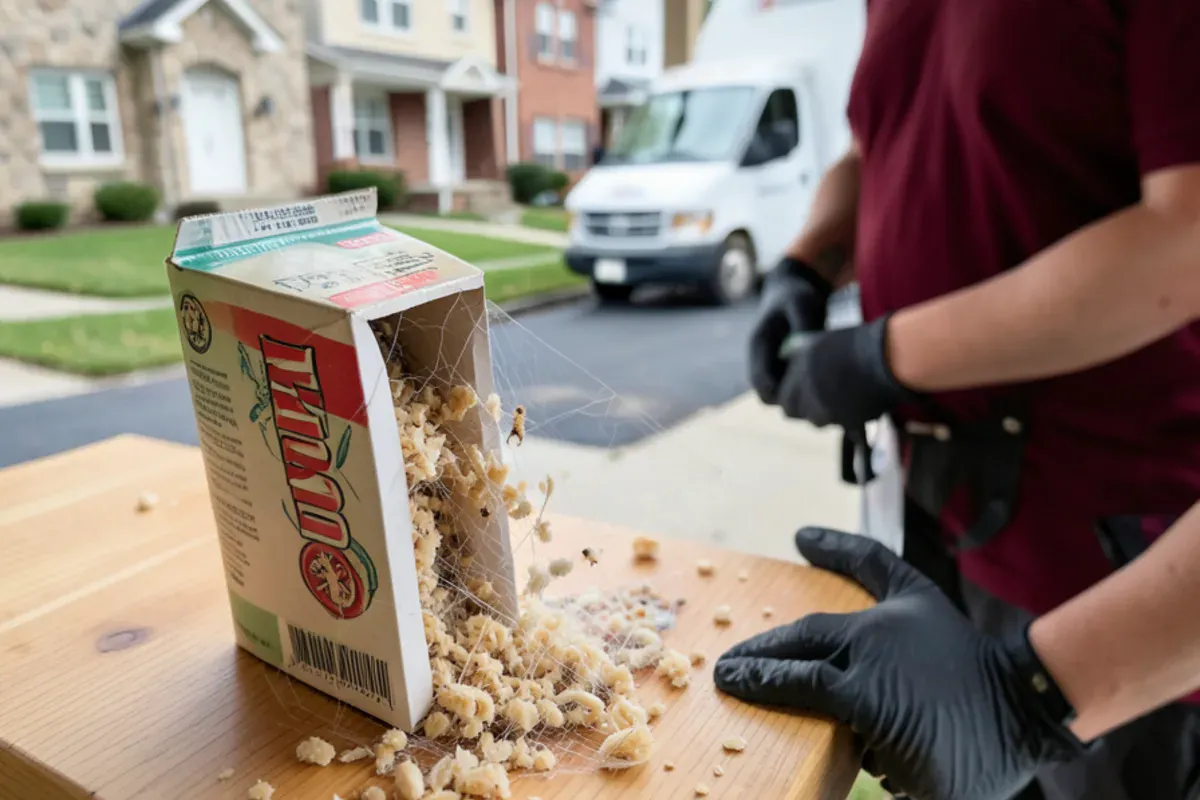
Signs pantry pests have spread beyond one box
Pantry pests reveal themselves slowly, and the timing tells you how long they have been there. In a warm kitchen, Indian meal moths take roughly a month or more to go from egg to flying adult, so moths seen in July often trace back to food bought in spring. Summer heat speeds every species up, while a cool basement pantry can hide a slow beetle problem for a whole season.
Look past the one package you found first. These signs mean the infestation has moved on:
- Moths resting on the kitchen ceiling, or fluttering out of a cabinet when you open it at night
- Cocoons or pale larvae in ceiling corners, door hinges and the tops of upper cabinets
- Beetles in the spice drawer, the dog food bin or a box of crackers you had not suspected
- Fine powder or frass collecting along shelf edges and in shelf-pin holes
- Webbing or small beetles on a bag of birdseed or grass seed stored in the garage
How stored product pests get into a clean kitchen
A pantry pest problem almost never means your kitchen is dirty. Most infestations arrive inside a package: a bag of birdseed from the garage, a box of cereal that sat in a warehouse, a bulk sack of rice, a bag of dry dog food. The eggs are too small to see, and larvae hatch weeks later.
From there, adults spread to anything they can reach. Sawtoothed grain beetles and young Indian meal moth larvae can chew through thin cardboard, paper and plastic film, and they slip through folded box tops. In older walk-up apartments, such as the units above shops in Media, a moth flight can also drift between kitchens that share walls and cabinet runs.
Clearing the pantry before treatment
Cleaning and treatment work hand in hand. Before or during our visit, go through every dry food item with these rules of thumb:
- Discard anything with webbing, live insects, larvae, or clumped, gray, musty contents
- Bag discarded food and take it straight to the outdoor trash
- Freeze unopened, unsuspected grain or flour for several days to kill hidden eggs
- Check spices, tea, pet food, birdseed and decorative dried corn or flowers, not only flour and cereal
- Vacuum shelf corners, hinge gaps and shelf-pin holes, then empty the vacuum outside
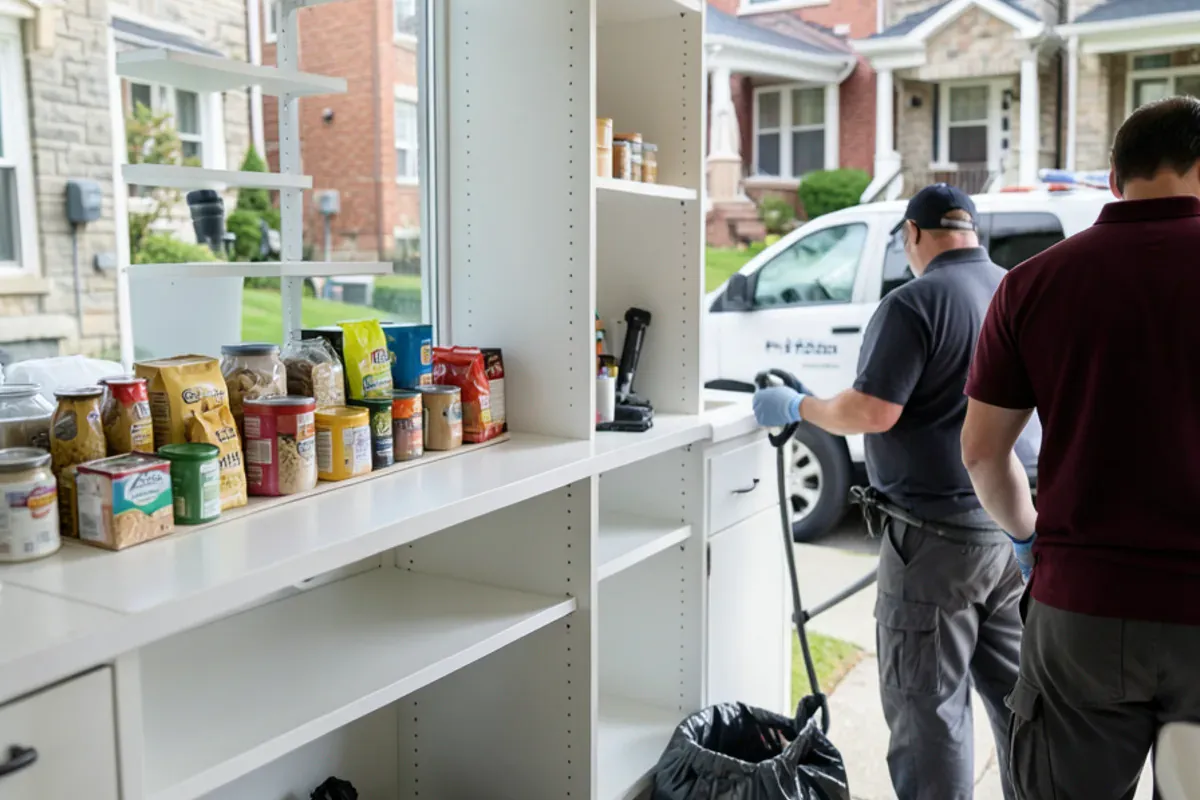
Can a pantry moth exterminator treat around food?
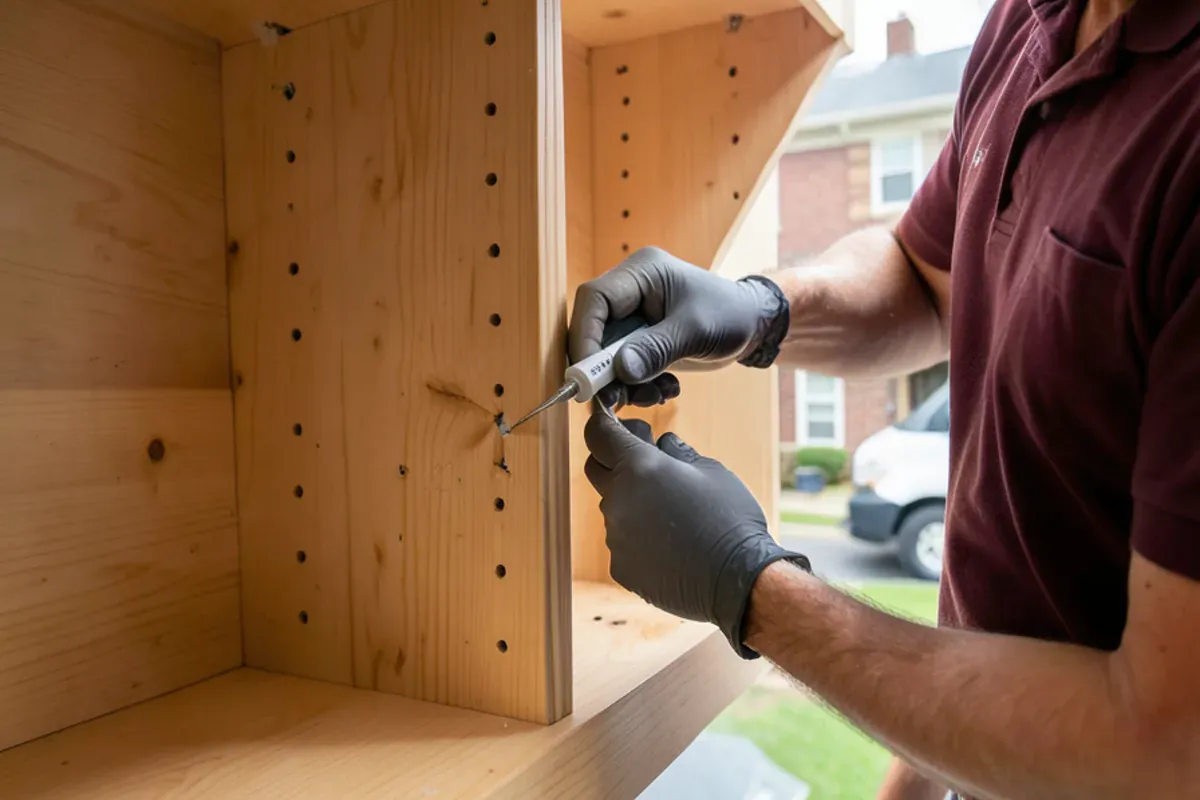
Yes, with care and with the cabinets emptied. Pesticides never go on food or food-contact surfaces. What we treat are the cracks and voids where larvae pupate and adults hide: shelf-pin holes, the joint between shelf and cabinet wall, the gap under the bottom shelf and the void behind the toe kick. Products are used according to their label directions for kitchens, and we tell you when it is safe to restock.
For Indian meal moths we add pheromone traps. They lure male moths, which disrupts mating and shows whether the flight is ending. Traps alone do not end an infestation, but they are the clearest way to measure progress.
Talk to us about pantry pest control
Call and speak with Thom or his team. The inspection is free, and you get a written quote before any treatment.
- ★ 4.8 from 21 Google reviews
- Open 7 days, 8 a.m. to 7 p.m.
- Free inspection before treatment
- Family-run, based in Media, PA
Open 7 days, 8 a.m. to 7 p.m.
Our pantry pest visit, in order
Find the source
We check the pantry, cabinets, the space under and behind appliances, garage storage and pet food bins to locate where the infestation started.
Confirm the species
Moth, beetle or weevil changes which foods to check and how long cleanup takes.
Quote in writing
After the free inspection you receive a written quote before any treatment.
Empty and vacuum
Affected cabinets are emptied and vacuumed so treatment reaches clean surfaces.
Crack-and-crevice treatment
We treat shelf joints, pin holes and cabinet voids, never open food, shelves where food sits, or counters.
Pheromone monitoring
Moth traps go up to track the adult flight over the following weeks.
How long until the pantry moths stop flying?
Expect a few adult moths or beetles for two to four weeks. Larvae that had already left the food to pupate, often in ceiling corners, behind the refrigerator or inside door hinges, will still emerge. Each one that lands in a trap is progress rather than failure.
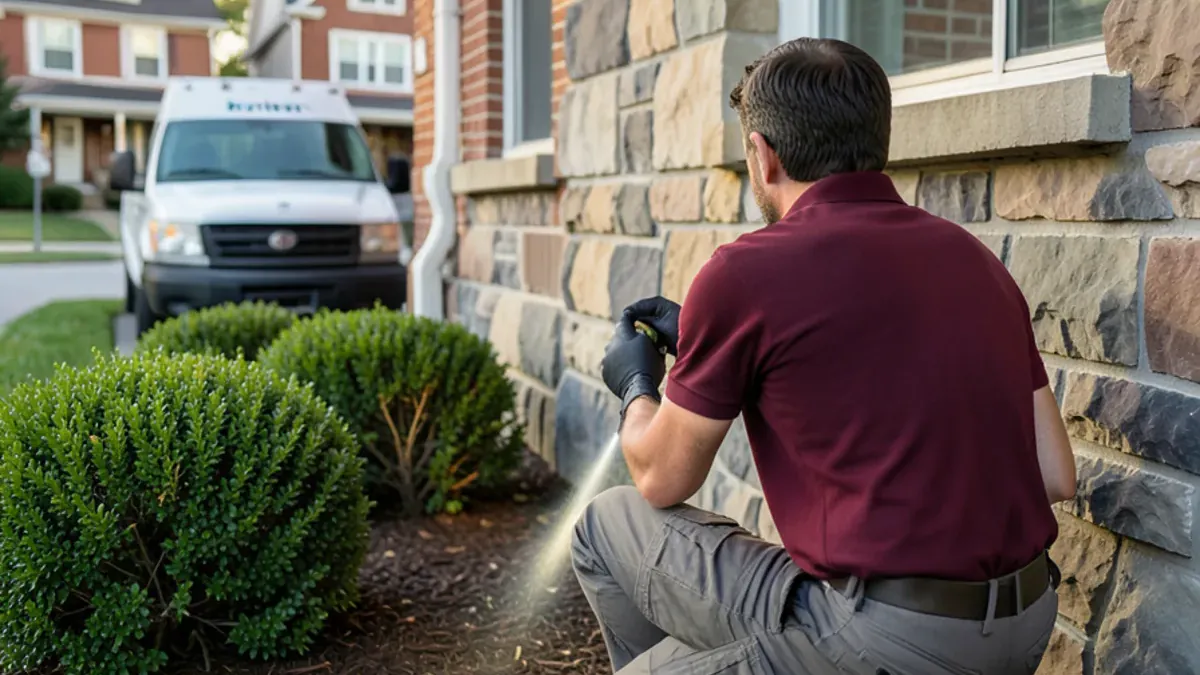
If new moths keep appearing after a month, there is usually a second source we have not found yet, very often birdseed, grass seed or pet food stored in a garage or basement.
Factors behind pantry pest control cost in PA
In Delaware County kitchens, layout and storage drive the quote. A Media walk-up with a single pantry cabinet is a small job, while a house with a kitchen pantry, a basement shelf of bulk staples and a garage holding birdseed and dog food has three possible sources to clear and treat. Older built-in cabinets with open toe kicks, shelf-pin holes and gaps behind the face frames give larvae more places to pupate and take longer to treat than sealed modern cabinet boxes.
Preparation changes the visit as well. A pantry that is already sorted, bagged and vacuumed lets us spend the time on cracks and voids instead of on emptying shelves.
Food businesses are handled under our commercial pest control service. For a home pantry, call (209) 563-1650 to book the free inspection.
- How many cabinets, pantries and storage areas are involved
- Whether the infestation has spread to garage or basement storage
- The species, since moths usually need longer monitoring than weevils
- Size of bulk food, bin or pet food storage
- A home pantry versus a commercial kitchen
- Whether a follow-up visit is included
Food-Area Pesticide Rules in Pennsylvania Kitchens
Treating a kitchen cabinet is a pesticide application like any other, and in Pennsylvania paid applications are governed by the Pesticide Control Act of 1973. The Pennsylvania Department of Agriculture (PDA) licenses pest control businesses, certifies applicators and, under 7 Pa. Code § 128.31, has the license number shown on service vehicles; ask for it before your cabinets are treated.
The product label decides the rest. Labels state whether a product may be used in food-handling areas, require food and utensils to be removed or covered first, and set how long before shelves can be restocked. That is why we ask for emptied cabinets and give you a restock time. Restaurants and food stores also answer to food-safety inspectors, so their stored product problems go through our commercial service.
Keeping pantry pests out long term
Our blog walks through more ways to keep pantry pests out from one season to the next.
- Store flour, grains, cereal, nuts and pet food in glass, metal or thick plastic containers with tight lids
- Buy bulk staples only in amounts you will use within a few months
- Date containers and use the older stock first
- Keep birdseed and grass seed in sealed bins away from the kitchen
- Wipe spilled flour and crumbs from shelf corners
- Check packages at the store for holes or webbing

What our pantry pest control includes
- Free inspection of pantry, cabinets, appliances and garage storage
- Species identification for moths, beetles and weevils
- Guidance on which foods to discard and which to keep
- Crack-and-crevice treatment of emptied shelves and cabinet voids
- Pheromone traps for Indian meal moths
- Restocking timing and storage advice
Why call No Bugs Exterminator for pantry pest control
Small and careful in kitchens
No Bugs Exterminator is a small, family-run business in Media, and Thom and his team work around food and family spaces with care.
Source first, then a price
We find the source on a free inspection, and the written quote comes before we treat a single shelf.
Homes and food businesses
We serve residential and commercial customers, so a moth problem at home or at work gets the same attention.
Open seven days
We take calls every day from 8 a.m. to 7 p.m., so moths found in the cereal on a Saturday morning can be booked without waiting for Monday.
Where we provide pantry pest control
Apartment kitchens produce many of our pantry pest calls. Census (ACS) estimates put renter-occupied homes at 58 percent in Media and 68 percent in Lima, where shared walls and cabinet runs let moths and beetles move between units. Drexel Hill, with the large Drexelbrook community, and the rowhome blocks of Upper Darby show the same pattern, so we often ask whether neighbors are seeing moths too.
- Springfield Township (Delaware County)
Post-war Cape Cods with attached garages often store birdseed, grass seed and bulk pet food, the hidden source behind many returning moth flights.
- Broomall
Restaurants and food shops around the West Chester Pike and Sproul Road crossing sit beside 1950s homes whose original cabinets hide moth cocoons.
- Radnor Township
Student rentals near Villanova share kitchens where bulk snacks and cereal turn over slowly, and Lancaster Avenue cafes need careful food-area work.
- Morton
A rail borough where 41% of homes are rented, so apartment kitchens with shared cabinet walls can pass beetles and moths along.
- Chester
Older riverfront rowhomes and a 60% renter share mean pantry pests can move between units through connected cabinets and pipe chases.
- Concord Township
Concordville retail at Routes 1 and 322 and newer homes with large pantries and bulk-buy shelves both see stored product pest calls.
- Bethel Township
1990s homes on former farmland often keep feed, birdseed and garden seed in garages and sheds, where Indian meal moths build up unnoticed.
- Wayne
Downtown Wayne's Lancaster Avenue shops and restaurants sit among Victorian houses with deep built-in pantries and plenty of cracks for larvae.
- Newtown Township (Delaware County)
Office break rooms near Routes 3 and 252 hold snacks and coffee supplies for weeks, and 1960s Newtown Square homes store dry goods pantry beetles can find.
What customers say on Google
4.8 out of 5 from 21 reviews on Google. Quoted as written by customers.
No Bugs Exterminator is the best I have seen. The owner is the nicest person in the world, he doesn’t rush anything, and is very thorough in job.
Excellent service, very professional and friendly! Most importantly the results gave me peace of mind! Highly recommended!
Very happy with the service, they helped me quickly to control the problem.
Pantry Pest Control: common questions
How do pantry moths get into sealed food?
Usually the food was infested before it was sealed, or the seal was not as tight as it looked. Eggs laid at a mill, warehouse or store hatch inside the package. Newly hatched Indian meal moth larvae are small enough to slip through folded box flaps, loose zipper seals and threaded lids that are not snug. Glass jars with gasket lids are the most reliable barrier.
What should I throw away after finding pantry pests?
Anything with webbing, live or dead insects, larvae, holes or a musty smell goes in a sealed bag to the outdoor trash. Opened packages of flour, grain, cereal, nuts, dried fruit, spices and pet food stored near the infested item are safest to discard too. Unopened cans, bottles and jars are fine. We help you sort questionable items during the inspection.
Can you treat a food cabinet safely?
Yes. The cabinet is emptied and vacuumed first, and treatment goes only into cracks, joints and voids, never on shelves where food sits or on counters. We follow each product's label directions for kitchen areas and tell you exactly when it is safe to put food back, so you are not guessing about restocking.
Are pantry moths the same as clothes moths?
No. Indian meal moths eat stored food, fly in the open and are drawn to light in the kitchen. Clothes moths are smaller, plain buff-colored, avoid light and feed on wool, silk and fur in closets. A moth fluttering around a living room lamp is far more likely to be a pantry moth that came from a kitchen or garage.
Why are there small worms on my kitchen ceiling?
Those are almost certainly Indian meal moth larvae looking for a place to pupate. When fully grown they leave the food and crawl up walls to ceiling corners, cabinet tops and door frames, where they spin cocoons. Finding them means the infested food has been there for weeks. Vacuum the larvae and track down the source package.
Related services


Helpful guides from our blog
Ready to get rid of the problem?
Thom and his team serve Media, Delaware County and southeastern Pennsylvania, open 7 days, 8 a.m. to 7 p.m..
- ★ 4.8 from 21 Google reviews
- Open 7 days, 8 a.m. to 7 p.m.
- Free inspection before treatment
- Family-run, based in Media, PA
Open 7 days, 8 a.m. to 7 p.m.